It has been a long time since I have posted here. We have been on a long spring vacation with the Silver dog House and as soon as we came home life became chaos. Our house is completely torn up for remodeling and rooms have been converted to different uses from when the children lived at home. So it was a scramble when one child asked to move back home for a few weeks. That is where we have been and what we have been doing. Thus I have not really felt like taking the time to post here.
SOOOO now that life is a little more settled, first I have to make time to look over the thousands of pictures I took over a five week period. Then I will start to post a diary of the trip as if it were being posted as it happened in real time. So I will need to back date the entries to match the actual dates when things happened. I am guessing some posts will be just a few pictures. Most of the pictures will eventually be posted to my Picasa photo albums and I will post links within diary entries. The photos will take some time to manage. So no one hold your breath, Nephew D, that means you :) but they will eventually get up.
Thursday, June 5, 2008

Tuesday, May 6, 2008
BIRDS - Monday and Tuesday, May 5 & 6

Wow what a place!! This birding secret I am going to keep! I have never seen so many different kinds of birds in such large numbers. I am not going to name this campground. Two days of birding has added a lot of new birds to my life list including a rare tropical bird that nests in the Mexico and only a very few mountain valleys of southern Arizona. We are nestled in a narrow canyon with a forest “scrub” Oak, Arizona Sycamore, Juniper, and pine. The deep, rocky sided, valley we walked up had HUGE Arizona Cypress which are very rare in the U.S, with a mixed forest that had other tall conifers mixed with the shinning whine trunks of the Sycamores. There was a rocky creek that ran through it sometimes with significant water, sometimes dry. The wall were sheer rock faces that did not let the sun into the floor until about 9:00AM.

Here are Richard and Duncan standing beside a very large Arizona Cypress
Our most exciting discovery in that valley were Elegant Trogons. We saw two males. These are a rare tropical bird that is native to Mexico and only a few canyons in southern Arizona. My picture is very poor at best - he was very hard to see in the shade of the thicket of tree branches. We found him only by his odd call. But we could see that his back was coppery green and we got a glimpse of his bright pink breast.

Everywhere we looked were new birds that are never seen at home. It was really strange to find Chipping Sparrows, a common native of home too, in large flocks. There were no House Sparrows and no Starlings. But some of the birds that were new for me on this trip were not here. The list for this place is long.
The Acorn woodpeckers were fascinating with their clown like coloring of Red, Black, and white and their raucous flocks that tumbled through the woods, like a band of preteen boys.
Another camper had put out orange halves and hummingbird feeders. They attracted Bullocks Orioles and Scott's Orioles which are yellow instead of orange. Broad tail, Black Chin, Blue Throated, and Magnificent Hummingbirds were at the feeder.
I also saw a Green Tailed Towhee, White Winged Doves, Gray-Breasted Jays, Pinion Jays, Steller's Jays. Ravens. Audubon's Warbler which is now lumped with the Yellow Rumped, Townsend's Warbler, Wilson's Warbler, Painted Redstart, Western Tanager, Hepatic Tanager, Black Headed Grosbeaks, flocks of Lark Sparrows, Yellow Eyed Junco,

Saturday, May 3, 2008
Gila Cliff Dwelings: Saturday, May 3
We rose fairly early and I got a real shower this morning because we have and empty gray tank and access to good fresh water.
The road to the Gila Cliff Dwelling National Monument was a very narrow and winding. But the scenery was worth the drive. This time of year the Gila river is fairly small but the river bed is wide and fairly deep. The foot path to the cliff dwelling wound through the narrow valley of the Gila and crossed back and forth. The history of the Ancestral Peobloans is fascinating, way too complicated to discuss here.

There was an interpreter at the top of the trial, at the ruin who was extremely knowledgeable and informative.
She answered a lot of questions we had about the area, and confirmed our guess that some of the rocks we were seeing were indeed volcanic. Millions of years ago this area had been extremely active volcanically. Which deposited a deep layer of sediment which consisted of volcanic ash and cobble from gravel size to small boulders. In some areas there were deep layers of pure volcanic ash. It was in these deep layers of sedimentation that the caves were formed.

The Cliff dwellings were built of slabs of this Gila Conglomerate, the volcanic ash and gravel cemented together by pressure, and mortar made by mixing water or urine with the dust that the volcanic ash part of the Conglomerate broke down into.
My pictures of cliff dwellings and pictographs that were at another site in the Monument are Here.
Duncan had to stay in a little kennel they had at the Cliff Dwelling contact center since dogs were not allowed in the ruins. They were dusty but otherwise “clean” and we used a padlock to lock him in.
On the way back "home" we stopped for homemade ice cream at a little tourist store.
The road to the Gila Cliff Dwelling National Monument was a very narrow and winding. But the scenery was worth the drive. This time of year the Gila river is fairly small but the river bed is wide and fairly deep. The foot path to the cliff dwelling wound through the narrow valley of the Gila and crossed back and forth. The history of the Ancestral Peobloans is fascinating, way too complicated to discuss here.

There was an interpreter at the top of the trial, at the ruin who was extremely knowledgeable and informative.
She answered a lot of questions we had about the area, and confirmed our guess that some of the rocks we were seeing were indeed volcanic. Millions of years ago this area had been extremely active volcanically. Which deposited a deep layer of sediment which consisted of volcanic ash and cobble from gravel size to small boulders. In some areas there were deep layers of pure volcanic ash. It was in these deep layers of sedimentation that the caves were formed.

The Cliff dwellings were built of slabs of this Gila Conglomerate, the volcanic ash and gravel cemented together by pressure, and mortar made by mixing water or urine with the dust that the volcanic ash part of the Conglomerate broke down into.

My pictures of cliff dwellings and pictographs that were at another site in the Monument are Here.
Duncan had to stay in a little kennel they had at the Cliff Dwelling contact center since dogs were not allowed in the ruins. They were dusty but otherwise “clean” and we used a padlock to lock him in.
On the way back "home" we stopped for homemade ice cream at a little tourist store.
Friday, May 2, 2008
Friday, May 2
I am sitting in the Silver Dog House in the driveway of a tire shop, typing the first half of this entry on the Pink Flamingo. White One the magnificent is disconnected from the trailer and in the bay getting his poor flat tire fixed. Duncan is with me sleeping, oblivious to the problems of travel. This repair should not take too long.
This morning it was COLD again, there was ice on the bottom of Duncan's water bowl and we dressed fast for the drive out of the campground with hopes for no more slow leaks in tires and to meet no one coming into the campground. The thermometer on White One says it is 23* We were not as early as we had hoped – 6:54 AM.

We did meet one vehicle not far from the campground but had no trouble getting around. The biggest problem turned out to be visibility with the sun already over the horizon and directly in our face on the dusty, sap specked, windshield. Washing it did not help much. But we arrived at US 180 with no unpleasant events in about 35 minutes.
We stopped for breakfast at a roadside litter barrel. In Michigan we have roadside tables here there are roadside barrels more often and no tables.  How the landscape has changed.

No more Ponderosa Pine. Now, where there are trees, they are the evenly spaced Cedars and Pinion Pines, competing for water. Where it is treeless there are bushes, with small chartreuse leaves beginning to come out and Yucca dotted thickly over the range land. Here the Yucca grows to at least six feet tall and sometimes branches near the top. Old bloom stalks, often several year's accumulation, stick up from the tops. I wonder if they are indicators of overgrazed range much like Hawthorns are indicators of overgrazing at home. The Prickly Pear cactus here have pads as large as a salad or even luncheon plate with thorns that look at least four inches long, unlike our native Prickly Pear at home with pads the size of teacups or smaller.

spring is beginning to show its face in the wildflowers that are blooming along the roadside.
We found this place in Silver City, NM to have the tire fixed. We were able to just pull into their parking lot, unhook the Silver Dog House and pull White One into the bay. And they did not charge us anything to fix the tire.
There was a Super Wal-Mart across the street where we tanked up on pop and chicken for lunch. Then called the local KOA where we dumped our tanks for $10 and they let us tank up on fresh water. They even gave us very good advice on what road to take to the Gila Cliff Dwelling and the campground we were looking for.
We passed a HUGE open pit copper mine. It is at least two miles long and maybe a full mile across. They have been actively mining there since the 1800's

The Campground turned out to be just fine, with clean pit toilets, good water, and nice hosts.
Thursday, May 1, 2008
Pueblo Creek, Apache National Forest: Thursday, May 1

The road that we came into the campground on is a gravel two track which crosses Pueblo Creek over the wreckage of a bridge and continues west to Arizona, no town listed on the sign, just Arizona. There bridge washed out at some point fairly recently and has been marginally repaired with gravel pushed over the wreckage. The crossing is marked as closed but we have seen several vehicles cross it and go on west. If we had the time we might have tried it but we need to have the tire fixed before we venture anywhere as we now have no spare.

Today we walked along Pueblo Creek which runs past the campground. The creek bed is wide and paved with huge jumbles of cobbles and boulders. The torrent that washed out the bridge is now mostly invisible. There is a small pool at one end of the base of the bridge and occasionally a small trickle of water showed itself among the cobbles. But for most of the walk the creek bed was dry. Part of the way we walked in the creek bed but later ventured onto a trail that climbed high on the face of the valley wall.


Part way along our walk we met two men with a small group of Pack Goats and a couple of dogs and chatted briefly. It was interesting to learn that Pack Goats are a growing "industry". There are a number of outfitters that use them in the back country. They are strong, and you do not need to carry any food for them. The dogs seemed to be pretty good at keeping the goats. The link above is the one they gave us.

Wednesday, April 30, 2008
Wednesday, April 30 - Day two at Pueblo Park campground.

I awoke this morning to the fantastic view through the curved window at my head. Ponderosa Pines were silhouetted against the sky as it began to lighten. The newly risen moon was hanging behind the tree tops above several lines of pale yellow clouds that gradually turned pale pink.

I call myself a tree hugger and here are some of the reasons why. These immense Ponderosa pines are so beautiful they almost make me weep. There was also morning bird song for the first time in the trip. Birds have been amazingly absent in many places. However we have seen some new life list birds for both of us:
Roadrunner
Western Bluebird
Pinion Jay
Spotted owl (heard not seen)
Dark Eyed Junco – gray headed Rocky Mountain race
Broad Tailed hummingbird
Great Egrets
We have also seen some old friends among the western birds and ones that are familiar from home:
Raven
Mockingbird
Western Kingbird
Stellar's Jay
Red Shafted race of the Common Flicker
Clark's Nutcrackers
Black Billed Magpie
Robin
Mourning Dove
Tree Swallow
Chipping Sparrow
White Breasted Nuthatch
Purple Martins (not really everywhere, We saw these in Wichita at Nephew S's home. It was a real treat as I have not seen any in years)
Crows
Cattle Egrets
Starlings
Grackles
Red Tailed Hawks
This morning the Robins started in singing, then a Flicker called and drummed. A bird with a trill followed by a couple of more clear notes has been calling all morning. Flocks of swallows also fly at treetop level both early in the morning and in the evening. They have bright white breasts and dark wings and tails and no other markings that I can see, so I will guess that they are Tree Swallows. The Stellars Jays are numerous and vocal.
Later in the day as we were sitting in the lawn chairs, one of the cutest animals I have ever seen boldly moved across the grass and jumped up on the picnic table. This squirrel had such large tufts of hair on his ears that they were almost the height of rabbit ears, he was gray with a brown back and white undersides including the underside of his very large bushy tail.
We have had very good luck so far with the truck and trailer – but today DH walked around White One and discovered a flat tire. What an ordeal, no nails just a leak, no idea where or when it happened. Thank goodness we made it into the campground and did not get stuck on the six mile access road. Once the tire was changed DH broke out the compressor and the generator to find the leak.
We are learning that the wind blows all the time during the spring in the west. The tree tops are really dancing in the wind but today there are only comfortable breezes at ground level with, a few gusts. We are dusty and dirty but who cares it is camping and there are NO sounds of other humans or of human machinery. All is quiet except the wind in the trees and the calls of the birds. The warmth has finally arrived today after the very cool spring weather we have been having.
For those of you interested in the solar on the Silver Dog House it is really putting out the Amps. The batteries are at 100%. For those of you who know what it means the battery is at 13.3 Volts (DH says 13.1 is good) and the panels are charging at 3.4 Amps. When I charge the laptop off the trailer batteries it draws down to about 75% but returns to 100% very quickly. Of course I can plug the many electronics we are carrying into the truck while we are on the road.

We are on open range here and although there seem to be fences and cattle guards between us and the herds there is a rather large red bull right here in the center of the campground enjoying the very fine very short fresh green spring grass.
It is very dry and between the wind and low rain fall the fire danger is very high. The ground is dry as a bone and very dusty. Everything is covered with a thick coating of grit. Yesterday we had the relief of fairly low winds. Today the wind started blowing after full sun up and continued to increase most of the day. It got really warm in the middle of the day but the temperature has dropped and I think it will be cold again tonight.
Monday, April 28, 2008
Monday, April, 28 from the Pecos River to Apache Springs

Today we left Field Track Campground. Arrived at the exit at 7:30. Stopped to chat with the Hosts and take pictures. It has been a good stay and the Hosts are really good folks.
Up the Pecos river valley, at the campground, no leaves are out on trees though the cottonwoods have catkins, and the shrubs bear a few very tiny beginnings of green. As we came down the valley the leaves were coming out and some trees seemed to be in heavy bloom, possibly they were Ash Leaf Maple (we did not stop to check the identification). As we came into the small town of Pecos flowering trees were beginning to show colored blooms.
The architecture here is really attractive. No buildings over two stories high and all of mission style either real adobe covered walls or if not adobe painted the tan and rust earth tones of the landscape. The building blend into the landscape and are not eyesores like so often happens in the north country of Michigan.

As we drive south on I-25 the country is becoming more and more arid. The occasional arroyo shows a topping of black columnar basalt where the flat terrain is broken by the arroyo. The Basalt at or very near the surface could explain why the country is so desolate looking. The rocky tan soil must be very thin and supports only scattered shrubs and very thin growth of last years grass. We saw only an occasional grazing cow. In the low areas there are trees, probably Cottonwoods and Ash Leaf Maple. Here at lower altitude than the campground they are showing small spring green leaves.
We crossed the Rio Grand river so suddenly I did not get a picture. The braided river flowed through a wide shallow typical western river valley with levies along the sides far from the small stream of water that is there now. Large wide topped trees grew all along the sides of the river right out to the levies. The trees must be really old to be so large, they are really narly looking. I think the large ones are Cottonwoods.
The agricultural landscape has changed suddenly. There are huge “basins”, surrounded by low burms, with what look like little trees with collars planted in rows in the basins. These basins extended about 400 feet back from the road to the foot of the hill behind. We discovered that
they are wine grapes after passing a building with a winery's name on it. These basins must be flood irrigated as we passed one very large irrigation ditch running full with water flowing straight toward the road down from the hill behind the basins creating an impressive "waterfall". It was amazing to see so much water running openly in this arid area.

The landscape changed repeatedly today. First we left a forest of Cedar, Douglas Fir and Ponderosa Pine with Cottonwoods along the Pecos River. We descended to arid grasslands that were interspersed with hills covered with thin woodlands of Cedar and Pinion Pine. At times we came down hills onto flat-lands where the road went straight as an arrow and disappeared between the next hills which we would then climb. The land was empty and beautiful in its
constant changes.
VLA = Very Large Array = It was right on the way to where we were headed, a campground on he Gila National Forest. If you have see SF movies you have seen the VLA.  This is not new technology but it is still providing researchers with radio photos as good as advanced optical Telescopes. We stayed long enough to take the walking tour and get up close to one of the antennae, each antenna is very large and the array extends in a Y formation that spreads across the high desert for 13 miles.

There were lots of Jackrabbits just hopping around mostly unconcerned about us.

We finally pulled into Apache Springs Campground in time for a late dinner of leftovers. The campground is very near the road but the grove of Ponderosa Pines in which it is located is spectacular.  I don't think I have ever seen any larger trees, not even the huge White Pines at Hartwick Pines State Park in Michigan (the last stand of virgin White Pine timber in existence in Michigan). Ponderosa Pine are also called Western Yellow Pine, and are closely related to our Red Pine from home. These trees are capable of growing to 150 feet in height and to a huge diameter. They are growing in an almost pure stand with just a few MUCH shorter but also mature Junipers and the ground covered with long tan grass from last year. The trees are breathtakingly spectacular and grow spread out like a planned park due to the shortage of water. The arid west does not allow for the dog hair growth of trees that we see in the much wetter midwest.
Saturday, April 26, 2008
Saturday, April, 26.
Freezing temps again last night. But we are warm under the wool blankets and the down sleeping bag.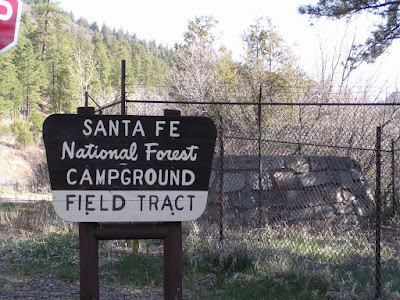

DH went and helped B, the camp host sweep off the top of the stone covered cistern which creats water pressure for the campground water spigots. M and B are really nice folks. They have been hosting this campground for 17 years. It is not a job either DH or I would like to do. They tell stories of the neighbors and locals that make it sound like their jobs can be hard to deal with, but they come back year after year and have also made friends here.
We walked part way up the “road” DH and Duncan walked yesterday. Wow I can sure tell we are over 6K feet of altitude. DH went to 8900 feet yesterday but we only went to 7700 feet today. It is a lovely Ponderosa Pine forest mixed with HUGE Douglas Firs and another fir I have yet to identify. They look like the Con-Color Firs sold as Christmas trees, but may be Subalpine Fir or some other kind. We stopped and watched the adult Clark's Nutcracker feeding young ones, and are amazed that they have young off the nest and fully grown already. The woods still look like winter, no snow on the ground at this altitude but no deciduous leaves breaking the buds yet and there are still very few birds in the woods. I wonder if it is still too early or just too barren in spite of, or maybe because of the large forest cover. The soil is hardly what we would call soil at home. It looks more like pea gravel only not so sorted for size nor so rounded in shape. The slopes are steep and there are sheer rock faces with interesting formations. Going up we met two white pick ups trucks coming down, moving very slowly in low gear. The first was carrying a load of Aspen trees balled, for sale? There were a few wildflowers in bloom. Oregon Grape, which I am used to as a largish shrub that can get as tall as a single story building, was very small, individual plants no more than 4” tall with one cluster of bloom and just a few leaves. It grew dispersed over the ground the way cactus do because of the shortage of water. There was also a very small white mustard of some sort also not more than about 4 or 5 inches tall. Yellow False Indigo, a species of Baptisia also called Rattle Pod was in bloom. They were much smaller plants, up to 12” tall and only a few stalks per plant, unlike the Baptisia in my garden which grows to three feet tall and spread a foot or more across at the ground. This is a DRY environment.
We had a fire in our own open fire pit tonight instead of going to one of the little log cabins.
Friday, April 25, 2008
Friday, April 25, Field Track Campground.

Freezing temps last nigh, there was ice coating sticks which were in contact with the water. Thank goodness for the furnace. We slept soundly to the sound of the Pecos River rushing over rocks in the channel and wind in the large Ponderosa Pines.
My stomach did not feel just right at bed time last night. Today I did not feel well – stayed close and read all day. Part of the day I followed the sun in my lawn chair as the shade moved. A large flock of very noisy Stellar's Jays moved through the campground, but there were few other birds. Not even many Chickadees and no Robins yet. It is still very early spring here. There are no leaves on the deciduous trees and little new green coming up. The wind was cold and it was hard to stay warm so I gave up and went into the trailer.
DH went for a long walk with Duncan up the mountain, across the road from the campground. He took the GPS with him and we stayed in contact through most of his walk. He called to have Clark's Nutcracker identification confirmed and then called to say they had found snow.
A whole flock of Magpies flew north up the river late in the afternoon. Migrating?
There are the cutest little fireplace buildings here. They are three sided log cabins with a rough stone fireplace and chimney that rises just about the peaked, shingled roof. After dinner we went down to the closest “cabin” and had a fire in the fireplace. It was very enjoyable.

While we were there a very large flock of swallows swirled around the campground at tree top height making their typical twittering sounds. They are high and all I can see is that they have dark backs and all white breasts.
Sleeping with the windows open is a dream. We can wear winter Pjs and snuggle beneath the wool blankets and the down sleeping bag/comforter. And be sung to sleep by the noisy/musical Pecos river rushing to the Rio Grand.
Thursday, April 24, 2008
Thursday, April 24 - Wagon Mound to Pecos, New Mexico
The wind came back up during the night and was very strong for a while.
Up at dawn, got dressed and moved on looking for a rest area to get breakfast. Found one about 5 miles down the road.
It turned out we did not need to be worried about our choice of places to spend the night. Someone else had spent the night in a van and across the street at the other gas station there were three large trucks doing the same thing. (as we traveled we would find that a lot of people slept in all sorts of places that you would never find happening back home) At the rest area there was a Mocking Bird singing his head off in a spruce tree. There were also some amazing Yuccas.
We were back on the road before 8:00 There are occasionally very large very dark birds soaring over the grasslands. They have pointed wings slightly canted upward and long round tails. AT first I thought they were dark phase Swainson's Hawks. But we later figured out they are Ravens. There are Ravens everywhere out here. Crows occasionally, but lots of Ravens. As we traveled south on I-25 the grade gradually changes from flat to rolling and the vegetation changes from grassland to mixed conifers.

The conifers look like very even aged mixed stands of Pinion Pine and Red Cedar. They grow so evenly spaced as to almost look planted. My memory, of long ago biology classes, tells me that their spacing is dictated by the water supply.

At Las Vegas, New Mexico we found a Visitors Information center, where we were directed to the National Forest Service office in town. From there it was suggested we might be able to camp at a campground north of Pecos. Although the campground is not officially open until May 1, we were told that the host is there and he might be willing to let us camp.
Just off I-25 we discovered Pecos National Historic Park. It was the site of an ancient pueblo and a mission established by Cortes. Duncan was welcome on a leash so we walked the trails between the old and new pueblos and the remains of the mission church. The mix of plants was interesting. Pinion Pine, Red Cedar, Choila, Rabbit Brush in bloom, Prickly Pear cactus, Yucca, and areas of grasslands. The short leafless trees we learned later were "scrub" oak.


The Pueblo was located on a hill overlooking the valleys below. Their 360 degree view afforded a strategically defensible location. There were two pueblos. The older one had been there before the Spanish arrived and the newer one, in close proximity to the church, was built by the converted Indians. There were also ruins of two churches. The first much larger than the second and built of stone rather than the adobe brick of the second. The remains of the second church were amazing. I am such a Midwesterner that this arid western climate always surprises me when I see how much of ancient ruins can survive even the periodic torrential rains.
When we reached the campground the host was most gracious and welcomed us to stay because we were carrying our own drinking water. This is a beautiful small campground in a mixed conifer forest on the banks of the Pecos River. The conifers are mostly large Ponderosa Pines with Douglas Fir and Red Cedar mixed in. We chose a partly shaded site right on the river.

I am looking forward to staying a few days in one place after the last two long days on the road. We are backed up to the Pecos river and it is running full and wonderfully noisy. We were able to hook our water up to the faucet and though we can't drink it because there is still too much chlorine in it we can wash and bathe with it. What luxury for a National Forest Campground.
Wednesday, April 23, 2008
Wednesday, April 23, - Leaving Wichita, KS
There was a rumble of thunder while we are getting ready to leave, and there are warnings of Thunderstorms here and for the area we will be going through. We are on our way west starting at 8:55 AM
We were up early the next morning and found another vehicle had used the same lot to spend the night.
Here is the mound that this very small town must be named after.
I am riding with my laptop computer that is of course Flamingo Pink to go with the Silver Dog House, on my lap. Today I will repeat the running commentary as we go.
(Now that I am editing these entries in August I do not much like the format but for this days of long drives I will leave them as they are)
Now we are seeing a few fields that have short dark stems from last year and white “trash” lying about. Cotton! I think these are the cotton fields that our Nephew D told us that they are starting to grow some.
The sky to the south is very threatening – solid gray, and it is windy - it is always windy it seems out west.
11:06 AM Large rain drops are hitting the windshield, and there is hail mixed in!!! we have pulled to the off the side of the road and are creeping along the shoulder. Hail sure sounds big on the roof of the truck. It looks pea size for the most part. We have stopped on the shoulder to sit it out. One car stopped across from us but moved on very shortly. Now it is mostly raining with just an occasional hail stone. There is one lightening flash and a bit of thunder. The rain is beginning to let up. - FLASH – every once in a while a rain drop sounds big – hope that is – FLASH – not any more hail.
11:18 We decide to move on, it is still raining hard but no hail now. Now the sky ahead is lighter and the rain is letting up a bit.
We just passed an old Airstream. Now that we are "streamers" we notice others and see more than we used to because we weren't looking before.
Whew 11:30 rain has let up and pavement is just damp here. That storm is the worst wind and rain with hail we have weathered with the rig.
These huge warm season grass fields are great pheasant habitat. It is very flat with only occasional trees or long lines of classic windbreaks composed of shrubs, with conifers on the south side and deciduous trees on the north side.
11:35 Another storm cell this time we pulled into a roadside park to sit it out, just in case there is more hail. HAIL a work that strikes terror into an Airstreamer's heart. The weather reports are predicting large hail with these storms in south west Kansas and north Oklahoma.
Wow we are going through Greenberg, Kansas in pouring rain. This is the town that was hit by a HUGE Tornado last year and was completely leveled, only the elevator was left. The devastation is still nearly total. Someone has propped a hand lettered sign “we are making tornado history” against a pole beside the road. The John Deere dealership is back up and running. and a few hoses and other buildings are scattered in the rubble. But the trees still look like my memory of news footage of the European theater in WWII.
Geez - It is pouring again and the visibility is terrible. Oh well this is western Kansas the only scenery is wheat fields and pastures and the occasional grain elevator.
This is certainly prairie; the soil is BLACK, and the only trees are in the drainages and around homes and farms, planted as wind breaks. They are haying the warm season grasses.
12:58 the sun is trying to come out thought the clouds are really low, almost fog.
We have left the green wheat fields behind us. Now great expanses of grassland and wheat fields alternate as far as we can see. Yucca is growing in the rough ground between the road and the RR tracks that parallel the highway.
Occasionally there are corn fields with overhead irrigation systems. Great wheeled monsters that pivot around their center point with hoses dangling from the connecting booms so the spray is delivered close to the ground in an effort to prevent as much evaporation as possible.
As we continue west the land continues to change. Now low eroded “badlands” are beginning to appear between the fields, more and more of which require irrigation. Sagebrush with the Yucca are beginning to fill uncultivated areas. The land is falling away from the prairie “heights” and it is beginning to look like the west instead of the prairie breadbasket .
4:56 PM We continue to drive through cells of thunderstorms at some point I sure hope we get behind this front. The wind and sometimes hail that comes with the rain are what we should expect from this part of the country.
We stopped at the “Mid-America Air Museum” in Liberal Kansas. The Museum is a very nice collection of non flyable aircraft in a former Beechcraft factory. The whole time we were in the museum the wind blew really hard. The museum has a B-25J Mitchell, a P-51 Mustang, an Avenger, and a really long list of more including everything from Ceasnas to an F-105.
The very nice lady at the museum offered to let us camp overnight in their parking lot since it was approaching the time of day that sane travelers settle in for the night. I was very tempted to take her offer but DH wanted to press on. He was sure we would find a friendly Wal-Mart parking lot when we connected with I-25 in New Mexico. We only have to get through the panhandle of Oklahoma and a bunch part of New Mexico. When we left we wound up in a really serious blow and pouring rain, again. It was really quite scary.
Now we are headed due west through the middle of the Oklahoma panhandle. New Mexico is about 90 miles ahead. The sun is shining with blue sky overhead and ahead, and the storms are behind us at last.
The country here is as absolutely flat as the proverbial pancake, mostly light tan colored range land and only occasional trees where there are houses but they are scattered far and few between. Occasionally a filed is plowed but it is really very barren looking. This is probably what our nephews were calling UGLY country. I think it sort of interesting if only because it is so alien to our experience.
When we crossed into new Mexico the landscape changed almost abruptly to look so much more like "out west". Instead of flat deep soils now bedrock is exposed, rolling hills covered with sage and yucca falling to dry stream beds paved with cobble. There are lots of Pronghorn in the fenced pastures. Surely Pronghorn are not the livestock these fences are for, where are the cattle?
When we eventually connected with I-25 there was nothing but the exchange, no Wal-Mart, not gas, no buildings at all. So on we go headed south looking for gas and an place to spend the night. Each exit was bleaker than the last - nothing along I-25 south.
Finally at 9:00 PM when it was nearly dark, we pulled off at Wagon Mound, New Mexico, Here is a tiny town and two gas stations. The one we picked was automated with not a soul in sight but there was an abandoned restaurant next door. The old unpaved parking area provided a place to park for the night. We turned on a minimum of lights, made and ate a tuna salad and crawled into bed. Wouldn't you know it? We picked a place next to a RR switch. Fortunately there was only one noisy train and we slept pretty well, even though Duncan got DH up twice during the night.
We were up early the next morning and found another vehicle had used the same lot to spend the night.
Here is the mound that this very small town must be named after.

Sunday, April 20, 2008
Day Seven
Today, as I write this is actually June 12. (It is not being posted until August 2) However I am writing as if we are still on our trip. Sunday April 20 is just a week into the trip. We have been visiting my brother and the Silver Dog House has spent the week parked in front of his house with the curb side wheel on the curb to get the refrigerator as level as possible. There is no where to camp closer than a two hour drive from Springfield Missouri so DH and I are sleeping in the guest bedroom at the back of their very cute house.
What follows is the running entry I typed in the Pink Flamingo - my laptop purchased for this purpose - as DH drove west.
Traveling I-44 west toward Kansas. MODOT has planted large patches Red Buds along the right of way fence. What a spectacular show!! They are in full bloom. There are also large plantings of flowering fruit trees, maybe plum or crab apple covered in white blooms. They have also planted White Pine in occasional groves. They are not native but have been here quite a while as they are good sized trees.
What follows is the running entry I typed in the Pink Flamingo - my laptop purchased for this purpose - as DH drove west.
Sunday, April 20, 2008
Before we left this morning I spent some time in the yard taking pictures. After several days of rain today is sunny. There is a large Redbud hanging over the fence into his yard and a beautiful pink dogwood in the back yard. I also got some pictures of my Brother but Sister-In-Law was still abed that early.
On the road again. Left brother's at about 9:00. I hope we will see each other sooner next time.
Traveling I-44 west toward Kansas. MODOT has planted large patches Red Buds along the right of way fence. What a spectacular show!! They are in full bloom. There are also large plantings of flowering fruit trees, maybe plum or crab apple covered in white blooms. They have also planted White Pine in occasional groves. They are not native but have been here quite a while as they are good sized trees.
Outcrops of bedrock that show themselves along the right of way cuts are wide dark layers with narrow bands of more fractured white rock between.
Just passed an Airstream that looked really odd. Very square but it said Airstream in large letters across the front “window”. Also passed an old aluminum trailer parked in a field. It had a square front and tail that flared out.
We are driving through flat pasture land with large herds of white cattle, I am guessing they are Charloit or Charloit crosses. And here is a large herd of Black Angus.
Flocks of turkeys with the males displaying are visible in fields between the woodlands.
10:41 AM enter Kansas
We have left I-44 just before entering Oklahoma and the toll road and turned toward Kansas instead. We are on a nice wide two lane.
There are still signs of the ice storms that occurred the last two winters. Brother lost a huge Elm in his front yard from last year's ice storm. It would be interesting to see a map of just how extensive the ice storms were. Weather does not seem to be as local here as it is at home.
Stopped for lunch at a rest stop on US-400 & US-169. The ice storm damage has disappeared.
Finally heard a Meadowlark and saw one as we were pulling out.
Back on the road at 12:45, 110 mile to Wichita should make it by about 3:00 PM
The landscape is beginning to roll more, there are some road cuts. The Flint Hills are north of us but unfortunately way out of our way on this trip.
This is certainly cattle country. Pastures full of cattle.
Scattered oil wells showing in some fields
Extensive areas of black pastures where they have been burned, to reduce weeds, and brush. The Red Bud seem to be fire resistant as they are in bloom in some of the burned area. The Red Cedar do not survive if they are small but what looks like gnarly oaks do just fine.
Truck thermometer says it is 79*. Warmest we have been so far, but a pretty stiff wind is blowing.
Sent an email from a rest stop with free wireless. As we pulled back out on the highway there was a large wind farm in front of us.
Warm season grass pastures spread on our right to the horizon. Pasture burned to the horizon on the left. Almost no trees.
Found Nephew's house with only a slight alteration from the directions. He has a 4 car garage with lots of space to just pull in and hook up.
Had a wonderful barbecue. All three brothers with their significant others and some children. Fabulous steaks with salads and lots of beer.
Nephew, S. and his wife W. have a 4 year old German Shepherd. She and Duncan have really hit it off, racing around the yard until they were ready to drop.
Saturday, April 19, 2008
Day six
We went to the Farmers market this morning, it was still cold and cloudy.
Brother gave me a Tai Chi basic lesson. He is a certified teacher.
The sun is back out and it is warming up.
Getting ready to continue on to Wichita tomorrow morning.
Brother gave me a Tai Chi basic lesson. He is a certified teacher.
The sun is back out and it is warming up.
Getting ready to continue on to Wichita tomorrow morning.
Friday, April 18, 2008
Thursday, April 17, 2008
Day four
Thursday, April, 17,
We slept well that night.
Toads are singing singing today.
Wow what a day yesterday. Brother took us on a float trip in canoes down the Buffalo River in Arkansas. The section we floated is a grade one white water river, open only in winter and spring, something we have never done before. Duncan went with us in the canoe, when Dick could keep him in. He bailed out several times. At the very beginning he bailed out twice before we could get him settled in to stay. This was a brand new experience for a nervous puppy. He was not at all sure he wanted to be in the canoe.
How to describe the experience? It was ten miles of aqua green water with the bottom ranging from small gravel to huge boulders and great sheets of limestone or sand stone, from ankle deep to over our heads so we could not see the bottom through the slightly cloudy, from the limestone, water, from smooth aqua pools to rapid riffles over dark cobbles, some a simple fast riffle, some faster drops with large boulders to maneuver around, some almost small waterfalls to go over, some straight shots, some sudden turns in the riffle or at the bottom. Twice there were close calls. The worst was when we wound up going through a tree in the river and when we got through could not find Duncan. He had gone overboard with a leash attached and it took a few seconds to find him. Another time we went over as small waterfall with a solid wall of water to enter at the bottom, I hollered and Duncan jumped out again. By the time we got him back near the canoe we were headed over another riffle on which we got hung up long enough for DH to drag Duncan back in the canoe by his collar.
We took a break in canoeing and walked up a feeder stream to the tallest waterfall east of the Rockies. The wind was blowing the water sideways in great drifts across the valley.
Wildflowers were in bloom in the woods as we walked up to the waterfall. it was spectacular. Spring beauties, Wood anemone, Wood Betony, purple and yellow violets, buttercups, wild phlox, rock phlox, tiny wild blue iris, Bell Flower.
It was a wonderful day. I did not take my camera for fear of getting dumped with the dog in the canoe but I found a series of pictures on Webshots that someone else took of the same section of the river. The waterfall pictures in the Webshots album are not a place we went but we did see where that stream emptied into the Buffalo River.
When we reached the take out point our car had been brought to us and we just left the canoes on the bank.
We slept well that night.
Toads are singing singing today.
We visited civil war battlefield today.
There were tiny pale blue and white 4 petaled flowers in bloom in the “grass” , mouse eared chickweed, gill over the ground.
I cooked my special version of venison loin chops for dinner.
After dinner we played the game – Worst Case Scenario and laughed until we cried.
Wednesday, April 16, 2008
Tuesday, April 15, 2008
Day two
Tuesday April 15.
Arrived at Brother's about 1:00 PM
Parked the rig in front of the house.
Made plans for a float trip tomorrow.
Slept pretty well. The trucks were not particularly disturbing.
Duncan had us up at 5:30 and we decided to get up and get moving
On the road again at 6:15 Frosty morning with a clear sky.
Large flocks of waterfowl flying over – not Canada Geese but can not identify short wingd maybe ducks.
Trucks are parked everywhere along the sides of expressway exits, and the rest areas are packed with the drivers sleeping
Still more trucks on the road than cars. Plus the trucks have slowed down a lot from past times when they just roared by.
WOW whew through St Louis.
I made one navigation mistake which made us miss the exit we needed. Not a total loss as we were able to go the the next exit and turn around. But it gave us a chance to see the Cahokia Indian mounds, One mound - amazing in height.
We are beginning to see bed rock and quarys.Crossed the Mississippi River on an impressive bridge.
As soon as we got into Missouri the landscape changed drastically. Now not flat farming land but steep hilly land. Cuts through limestone hills to build the roads.
Redbuds, and Amelancier, are blooming wild in the woods, flowering quince in bloom planted along the highway.
Red Cedar scattered through the hardwoods that look like White Oak.
Passing Six Flags- impressive.
I drove for a couple of hours and now that we are nearing Springfield DH has taken over again at the last rest stop before Springfield.
This is the second Rest Area that they are mowing the lawns at. Dandelions and some purple flowered low growing mint are in bloom in the grass.
We are passing through an area where there must have been an ice storm recently. The tops of the oaks are broken and hanging and in some areas there are a large number of trees broken right off and to the ground.
Arrived at Brother's about 1:00 PM
Parked the rig in front of the house.

Made plans for a float trip tomorrow.
Subscribe to:
Posts (Atom)


